Tuesday, March 8, 2022

Ningbo unveils measures to boost five emerging industries

 Ningbo in East China's Zhejiang province recently unveiled a total of 10 measures to boost the development of five emerging industries in the city.

The five sectors are healthcare, industrial Internet, 5G+, digital economy, and intelligent logistics.

According to a government guideline on accelerating the development of key emerging industries released in March, the city aims to develop emerging industries into important engines of local economic growth.

By 2025, the added value of the healthcare industry is expected to account for 7.5 percent of the city's total GDP, and it is hoped that the output of core industries in the digital economy will make up 9 percent of the city's GDP.

By the time, Ningbo hopes to increase the value of the city's cross-border e-commerce imports and exports to over 200 billion yuan ($28.98 billion), while the goal for online retail sales is set at 450 billion yuan.

These 10 measures are expected to help achieve these goals. Eligible companies are entitled to a government subsidy of up to 10 million yuan.

The city will also ramp up efforts to attract investment in these five emerging sectors and motivate enterprises to extend their industrial chains.

Efforts will also be made to strengthen the resilience of the enterprise industrial chain, accelerate the development of innovative start-ups, and spur innovation among enterprises.

In addition, local authorities will facilitate the construction of new infrastructure such as 5G base stations, internet of things, and smart agriculture, speed up the commercialization of scientific and technological achievements and push ahead with the implementation of application scenarios.

It will also advance cooperation with research organs to develop core technology and step up efforts to attract global talent.

Ningbo ranks high nationwide in 5G construction


Ningbo ranks high nationwide in 5G construction

Ningbo is now home to nearly 5,000 5G base stations, and that figure will increase to 7,000 by the end of this year, with signals covering all jurisdictions above the township level. [Photo/WeChat account: nbfb0574]

Ningbo in East China's Zhejiang province ranked fourth nationwide in terms of its 5G network construction, a recent report by China Mobile shows.

The report evaluated cities across the nation based on indicators such as network testing results, network infrastructure capacity, and city size.

Ningbo topped the country in terms of network testing, despite placing fourth overall, the report said.

In recent years, the city has ramped up construction on its 5G network infrastructure as a way to promote the integration of the digital and real economy and facilitate industrial transformation.

To date, it has constructed nearly 5,000 5G base stations and plans to increase that figure to 7,000 by the end of this year, with signals covering all jurisdictions above the township level.

Meanwhile, efforts have also been made to promote the industrial application of 5G technologies in a vast swath of sectors.

So far, the Ningbo branch of China Mobile has released more than 40 5G applications in sectors such as auto parts, energy and chemistry, textiles and garments, high-end equipment, intelligent home appliances and biomedicine.


Investing in Ningbo, Zhejiang China

 In this city profile, we highlight the reasons that make investing in Ningbo a feasible alternative for international companies looking to establish an operation in China. Ningbo offers opportunities in areas that optimize integration of manufacturing technology and information technology as well as in the expanding advanced manufacturing and modern service industries.
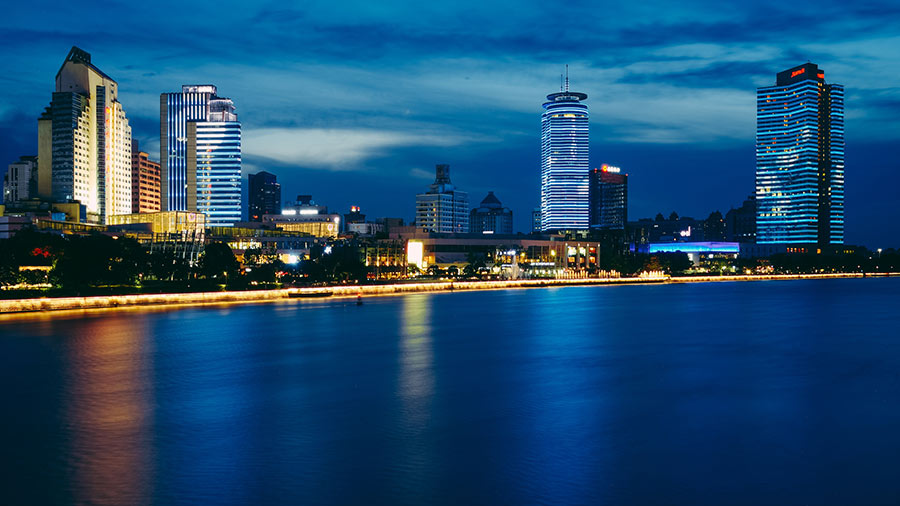
Investing in Ningbo

Why should you consider Ningbo?

Ningbo is a major sub-provincial city in the northeast of Zhejiang Province. As the southern economic center of the Yangtze River Delta, Ningbo has always been a city of historical and economic importance in international trade. With the world’s largest cargo throughput and the world’s third largest container volume, the Port of Ningbo-Zhoushan is a multi-functional, comprehensive, and modern deep-water port integrating inland, estuarine, and seaport.

As a city with advanced manufacturing industrial clusters and port-adjacent industrial clusters, Ningbo has profitable enterprises in green petrochemical, automobile manufacturing, and high-end equipment production, among others. The green petrochemical industry facilitates agglomeration of upstream and downstream industries in the large-scale refining-chemical integration base.

Ningbo has nine national development zones, five national demonstration bases of emerging industrial sectors, and many leading enterprises and single champion enterprises showcasing innovation. In August 2019, China’s General Administration of Customs magazine published the 2018 ranking of China’s Top 100 foreign trade cities, with Ningbo ranking eighth.

Given the continuous promotion of Ningbo’s industrial upgrades, foreign-funded enterprises can also invest in opportunities arising out of the city’s transformation of its traditional industries, such as in smart manufacturing, among other fields. The Ningbo Bureau of Commerce has said that to improve the regional business environment, Ningbo would open its economy further and provide more sustained and robust support for foreign investment.
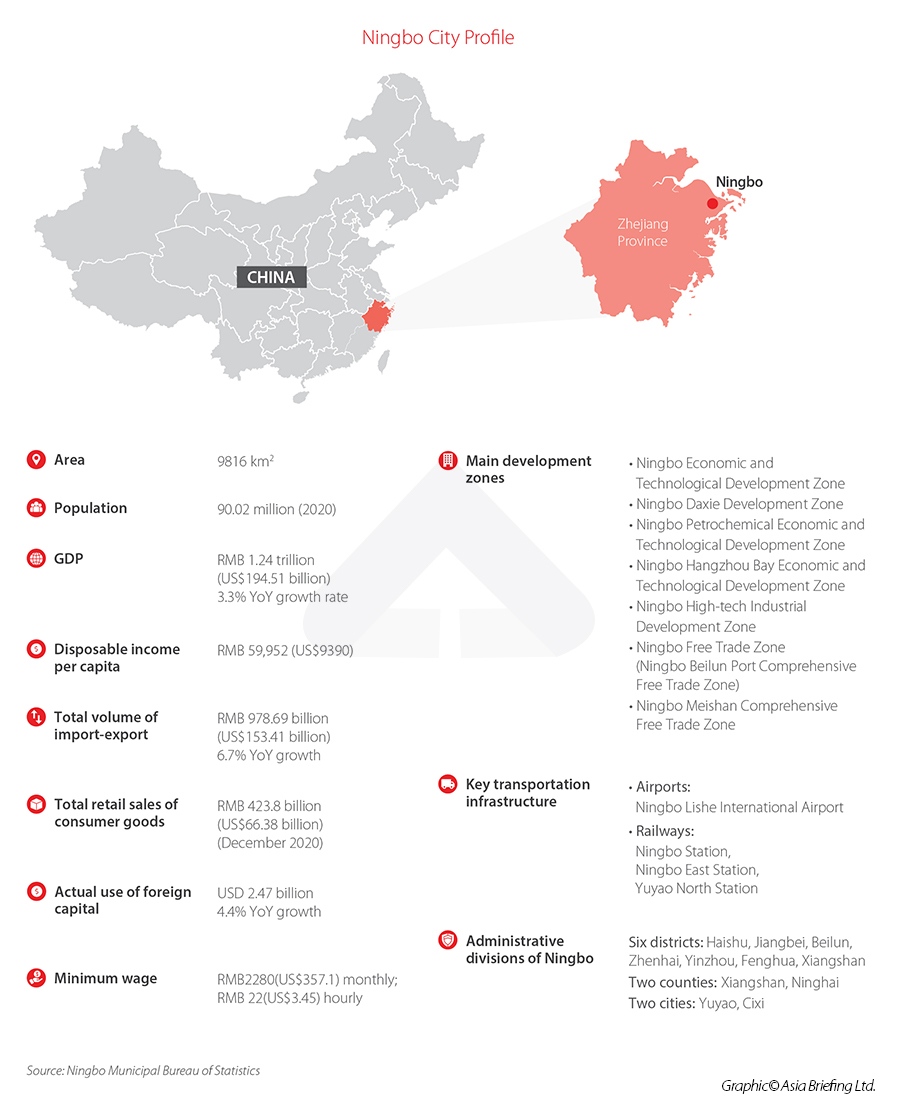
Ningbo Map, Fact Sheet

Ningbo’s economic profile

According to the Ningbo Bureau of Statistics and the National Bureau of Statistics of the People’s Republic of China’s preliminary calculation, Ningbo achieved a regional gross domestic product (GDP) of RMB 1,240.87 billion (approx.US$194.51 billion) in 2020, representing a 3.3 percent increase from 2019. The overall recovery is better than the national and provincial level; out of China’s 300 cities – Ningbo ranked 12th.

Ningbo GDP 2016 to 2020

Based on the industrial structure in 2020, the added value of the primary industry was RMB 33.84 billion (approx.US$5.30 billion), up 2.1 percent. The secondary industry of the economy was RMB 569.39 billion (approx.US$89.25 billion), up 3.0 percent. The tertiary sector of the economy was RMB 637.64 billion (approx.US$99.95 billion), up 3.6 percent.

The contribution of the primary, secondary, and tertiary industries to GDP growth were 1.7 percent, 44.5 percent, and 53.8 percent, respectively.
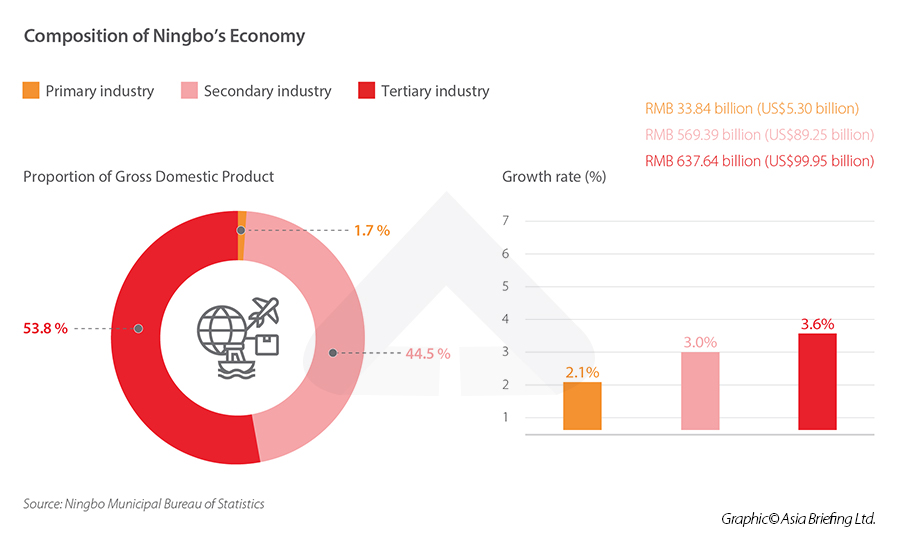
Ningbo economy

Foreign trade and investment landscape

In 2020, Ningbo’s foreign trade situation gradually recovered from the COVID-19 pandemic. The volume of trade in goods totaled RMB 978.69 billion (approx.US$153.41 billion), an increase of 6.7 percent. Exports amounted to RMB 640.70 billion (approx.US$100.43 billion), up 7.3 percent and imports RMB 337.99 billion (approx.US$52.98 billion), up 5.6 percent. Mechanical and electrical products accounted for 55.1 percent of the city’s total exports.

In terms of trade partners, there are 224 countries and regions that directly trade with Ningbo, among which the import and export volume to the US, EU and ASEAN reached RMB 173.53 billion (approx.US$27.17 billion), RMB 170.78 billion (approx.US$28.00 billion) and RMB 107.95 billion (approx.US$16.91 billion) in 2020, up 22.0 percent, 7.2 percent, and 10.5 percent, respectively. Ningbo’s imports and exports to 65 countries along the “Belt and Road” amounted to RMB 276.42 billion (approx.US$43.33 billion), up 4.9 percent, including RMB 29.52 billion (approx.US$4.63 billion) to 17 countries in Central and Eastern Europe, up 3.7 percent from 2019 to 2020.

Ningbo attracted 486 foreign-invested projects worth US$4.70 billion by the end of 2020. The city’s actual use of foreign investment stood at US$2.47 billion, up 4.4 percent. Of this total, 411 new projects were approved by the tertiary sector, representing an increase of 19.0 percent in the actual utilization of foreign capital of US$1.35 billion.

Investing in Ningbo: High level transition to industrial internet industry, modern services

Industrial internet industry

Ningbo has a strong advanced manufacturing industrial cluster. In 2020, the added value of the manufacturing industry in the city reached nearly RMB 569.39 billion (approx.US$89.25 billion), accounting for 44.5 percent of GDP.

There are more than 120,000 manufacturing enterprises, including in textile, garments, home electric appliances, plastic machines, auto parts, stationery, and mold. Since most enterprises engage in traditional manufacturing, their upgradation involves the industrial internet industry, for example, through automation. This will help local manufacturing entities improve efficiency, move operations up the industrial value chain, and expand the region’s overall production capacity.

Ningbo aims to speed up the deployment of industrial-level internet platforms for its enterprises manufacturing high-end equipment, auto parts, textiles and clothing, intelligent home appliances, etc.

Enterprises in the region are also actively researching and developing chips for industrial computing, strengthening intelligent equipment, such as complete sets of automation; nurturing and developing industries, such as intelligent sensors; and developing low-level hardware and basic cloud platforms.

Modern services

Since the 13th five-year plan, Ningbo has prioritized the development of the services sector as an essential way to speed up economic transformation. Consequently, the services sector surpassed the local manufacturing sector for the first time in 2019, accounting for 49.1 percent of GDP. By 2020, the city’s service industries’ added value was projected to account for 53.8 percent of the city’s GDP. The services sector is now a driver of local economic growth and the main source of Ningbo’s tax revenue.

Ningbo’s tertiary / services sector structure has been optimized, and breakthroughs have been made in finance, commerce, science and technology, and information services industries; the proportion of producer services in the tertiary sector has risen to about 60 percent.

A key tertiary industry in Ningbo is trade service, whose growth has accelerated in recent years. The import and export volume of trade in goods in Ningbo accounted for 3.04 percent of China’s total trade in goods in 2020, ranking sixth among all Chinese cities. The import value of cross-border e-commerce online shopping has been ranked first in the country for three consecutive years. These demonstrated the efficiency and appeal of Ningbo’s trade services. Investors interested in Ningbo should pay attention to opportunities in this area.

Where to set up in Ningbo

Economic and Technological Development Zone

Founded in 1984, with a total area of 29.6 square kilometers, Economic and Technological Development Zones in Ningbo are among China’s earliest and largest national development zones.

Relying on the advantages of ports and their development linkages, the Economic and Technological Development Zones of Ningbo (Beilun District) has formed a port-adjacent industrial cluster with the automobile, equipment, petrochemical, steel, and energy as its focus. After more than 35 years of development, integrated circuits, high-end equipment, new materials, etc. are other emerging industries.

The Economic and Technological Development Zone host a large number of frontier enterprises, such as Geely, Shenzhou, and Haitian. There are 784 industrial enterprises located here, out of which 11 enterprises have an output value exceeding RMB 10 billion (approx.US$1.57 billion), 58 enterprises have an output value exceeding RMB 1 billion (approx.US$0.16 billion), and 18 companies are listed at home and abroad.

Ningbo Daxie Development Zone

Established in 1993, Ningbo Daxie Development Zone benefits from the state-level economic and technological development zone policy. Through 27 years of development and construction, Daxie has come to focus on port development, green petrochemical, and new chemical materials industries.

As a modern port area, the Daxie Development Zone ranks among China’s top 10 comprehensive port areas. The world’s largest 450,000-ton crude oil terminal is here, accounting for 21 percent of the total number of berths in Ningbo. The zone is thus well poised to develop the green petrochemicals industry. It aims to become an international energy trade center and a leader of energy reform in China.

Ningbo Bonded Zone (Ningbo Beilun port comprehensive bonded zone)

Established in 1992, Ningbo Bonded Zone is the earliest bonded area in Zhejiang province. Later in 2002, the State Council approved the establishment of Zhejiang Ningbo Export Processing Zone in Ningbo Bonded Zone, which is the second batch of export processing zones in China. On April 27, 2020, the State Council approved the transformation and upgrading of the original area of Ningbo Export Processing Zone to Ningbo Beilun Port Comprehensive Bonded Zone. In September 2020, Ningbo Beilun Port Comprehensive Bonded Zone was included in the scope of Zhejiang Free Trade Zone (Ningbo Area). At present, the zone accounts for nearly 10,000 enterprises of various types; in 2020, the region’s total production value was RMB 20.18 billion (approx.US$3.16 billion), an increase of 6.6 percent.

After more than 20 years of development, the area has focused on four functional industries – international trade, processing and manufacturing, bonded logistics, and digital. In the area of international trade, it has gathered more than 3,500 international trading enterprises. There are platforms for cross-border import e-commerce bases, imported goods markets, imported goods direct sales centers, and Central and Eastern European Specialty Products Perennial Exhibitions. In processing and manufacturing, focus is on the development of the electronic information industry and strategic emerging industries. In bonded logistics and digital, the zone has gathered more than 330 warehousing logistics enterprises. In recent years, the Ningbo Beilun port comprehensive bonded zone has accelerated digitalization of logistics, developed intelligent logistics, and promoted cloud warehouses’ construction.

City-wide incentive policies

To encourage overseas investors to invest locally, Ningbo City implements various incentive policies for foreign investment projects that meet certain industry requirements.

  • Promote overseas investors’ direct investment with distributed profits: Qualified non-resident enterprises can defer withholding income tax payment as long as they reinvest equity investment incomes, such as dividends and bonuses derived from resident enterprises directly into projects and sectors not prohibited by the country.
  • Ensuring land supply for major foreign-funded projects: Foreign-funded projects will be given priority in land application.
  • Promote fair competition between domestic and foreign-funded enterprises: Foreign-invested enterprises can fully enjoy various industrial support policies and participate in government procurement bidding fairly.
  • Innovative capital management of foreign-invested enterprises: Allow qualified foreign-invested enterprises to borrow funds in domestic and foreign currencies from abroad. Foreign investors can freely remit their investment income in RMB or foreign exchange in accordance with the law.
  • Expand financing channels for foreign-invested companies: Encourage foreign-invested companies to go public, list on the New Third Board and Ningbo Equity Exchange Center, support the use of non-financial corporate debt financing instruments for financing.
  • Optimize the foreign investment management system: Actively promote the “Internet + government services”, simplify the management procedures of foreign investment projects, and shorten the registration time for foreign investment enterprises.
  • Optimize the environment for overseas talents: Overseas talents can enjoy a series of preferential policies in visa and work permits application and can get access to all other kinds of social welfare.
  • Improve the business environment for foreign investment: Ningbo government promises to help foreign invested enterprises solve issues met in business operation and employee management in a timely manner.

Tuesday, June 18, 2019

Ningbo English Speaking Lawyer trademark attorney patent attorney From Chinese Intellectual Property Law Firm Offer IP Legal Services in Ningbo And Other Yangtze River Delta Area

Shanghai intellectual property lawyer

Ningbo is a harbor city in Zhejiang province and one of China’s most prominent ports. The Ningbo-Zhoushan port is the fifth-largest in the world and the third-busiest in China after Shanghai, Shenzhen and Hong Kong. It is bound by the East China Sea and Zhoushan Archipelago in the east, by Hangzhou Bay in the north, by Shaoxing in the west, and by Taizhou in the south. In 2007, the Hangzhou bay bridge was built, connecting Ningbo with its neighbors. Ningbo has established intermodal rail services that connect it to 13 inland ports. It also has the largest specialized dock for storing liquefied chemical products in China.

Ningbo serves as the economic center for the southern Yangtze River Delta and has been ranked among the most competitive cities in China. The municipal government of Ningbo encourages foreign investment and various multinational corporations (MNCs) have established operations in and around Ningbo. In 2013, Ningbo’s GDP reached US $108.3 billion (RMB 712.89 billion), up 8.1 percent year on year with an annual growth rate of 9.26 percent. Ningbo’s exports totaled US $65.7 billion while imports amounted to US $34.6 billion. The city ranked second in economic performance for Zhejiang province in 2014, trailing only Hangzhou

Ningbo has a sister city relationship with four cities in the U.S. – Wilmington, Delaware (1988), Houston, Texas (2000), Milwaukee, Wisconsin (2006) and Norfolk, Virginia (2013).
With rapid economic and scientific development shaping the commercial landscape in China, protecting ideas and innovation is the key to safeguarding China’s market competitiveness and an emerging generation of entrepreneurs. Offering strategic commercial solutions and an enviable track record in disputes, we work with you to solve your most significant challenges across patent, trademark, intellectual property (IP) legal and IP litigation

With rapid economic and scientific development shaping the commercial landscape in China, protecting ideas and innovation is the key to safeguarding China’s market competitiveness and an emerging generation of entrepreneurs. Offering strategic commercial solutions and an enviable track record in disputes, we work with you to solve your most significant challenges across patent, trademark, intellectual property (IP) legal and IP litigation

We work with Chinese intellectual property law firm that help clients worldwide protect their Chinese intellectual property rights through patent, trademark, and copyright services, as well as through litigation when necessary. Our experienced attorneys and technical experts can assist you even in the most difficult Chinese intellectual property cases. In fact, those challenging cases are our specialty. We also know that many of our clients may be intimidated by the complexities of Chinese IP law, and that is why we are prepared to not only protect your ideas, but also to help you understand those rules and restrictions.

If you have intellectual property, you need to take the steps now to protect it in China in order to maintain ownership of this valuable asset and to prevent others from misusing your innovation. The best protection is prevention. Through our computerized management, advanced communication, and competitive pricing, our specialized legal team will secure your rights, your financial compensation, and your peace of mind. 


We provide legal consultation and services for the prosecution and litigation of patents, copyrights and trademarks, unfair competition and trade secret matters. Our legal associates are specifically qualified to assist clients with business matters concerning the acquisition, protection and exploitation of all forms of intellectual property.


Our IP Legal Services
Trademark
Trademark Legal Service
Trademark application agency
Report on trademark retrieval;
Advice on trademark application by trademark laws and regulations in China;
Application for trade mark.
Other Agency
Trademark inquiry, renewal, transfer, modification, authorization record, opposition, review, etc.
Trademark Infringement Combating
Against the manufacture, sales, publicity, payment and other aspects concerning trademark infringement.
Method: litigation, administrative complaint, trademark record in custom.

Copyright
Copyright Application
Copyright registration of literary works, fine works, software works, music works, etc.
Infringement Combating
Against any website infringing the copyright of literary works, fine works, software works, music works;
Scope: comprehensive combating on infringement related to the infringing website’s domain name, IDC hosting, website promotion, pay link and other aspects.
Method: lawyer’s letter, administrative complaint, litigation.
Policy Consultancy
Our attorneys are expert in China laws and administrative policies on copyright.
Other Services
Drafting, examination, modification on copyright contract and other legal documents related

Patent
Administrative Affairs
Drafting patent application, patent claims and other documents
Patent application;
Paten re-examination application, drafting application document, re-examination statement or reasons and other documents;
Invalid patent application, drafting application document, statement or reasons and other documents;
Communication and negotiation with patent officer in the process of patent application and dispute settlement.
Patent Strategy
Establishment of patent protection system, determination on the protection scope of peripheral patent and the establishment of patent pool.
Patent Transaction
Drafting and examination on the contract of patent sales, transfer and license;
Patent contract record and registration;
Investigation on patent ownership;
Assessment on patent value.
Litigation
Administrative litigation;
Infringement litigation;
Patent ownership confirming litigation.

Trade Secrect
There has promulgated no Trade Secret Law in P.R.C, while the regulations concerning trade secret are respectively provided in Anti-unfair Competition Law, Labor Contract Law and other laws or regulations, such complicated legislation makes it crucial for international companies in China to maintain the legality and effectiveness of any legal documents containing trade secret.
Drafting and Modification of Legal Documents
Localizing clients’ documents related to trade secret by China laws and regulations;
Drafting various legal documents concerning trade secret on clients’ demands, including the Confidential Articles of Association, Non-infringement Undertaking, Non-disclosure Agreement, Non-competition Agreement, Project Non-disclosure Agreement, Confidential Undertaking, etc.

Litigation
Acting in dispute of competition restriction, trade secret infringement, as well as criminal report and acting in crime of infringing trade secret case.
Field of business activities: Intellectual property (Copyright, Patent, Trademark, Trade Secret) ;Corporation affairs; Foreign investment).

Our lawyers have accumulated wide experience of IP Legal Services  in Ningbo And Other Yangtze River Delta Area


Yangtze River Delta cover following area:

Besides Shanghai, four cities in Jiangsu (Suzhou, Wuxi, Changzhou, Nantong) and five cities in Zhejiang (Hangzhou, Jiaxing, Shaoxing, Huzhou, Ningbo) were included. In 1992, a 14-city cooperative joint meeting was launched. Besides the previous 10 cities, the members included Nanjing, Zhenjiang and Yangzhou in Jiangsu, and Zhoushan in Zhejiang. In 1997, the regular joint meeting resulted in the establishment of the Yangtze River Delta Economic Coordination Association, which included a new member Taizhou in Jiangsu in that year. In 2003, Taizhou in Zhejiang also joined the association. In 2010, the association accepted six new members after a six-year observation and review, including Yancheng and Huai'an in Jiangsu, Jinhua and Quzhou in Zhejiang, and Ma'anshan and Hefei in Anhui. The total number of cities in the Yangtze River Delta Economic Coordination Association is now 22.[6] Some other cities that have been in consideration and in review include Wenzhou and Lishui in Zhejiang, Lianyungang and Xuzhou in Jiangsu, and Chuzhou, Wuhu, Tongling, Huainan and Xuancheng in Anhui.
Image result for Yangtze River Delta

Our service team has helped many international corporations to invest in China and protect their intellectual property rights.


Contact Tom Lee  if you need Ningbo English Speaking Lawyer trademark attorney patent attorney From Chinese intellectual property law firm Offer IP Legal Services in  in Ningbo And Other Yangtze River Delta Area

Sunday, June 2, 2019

Ningbo Free Trade Zone

Ningbo Free Trade Zone
Ningbo Free Trade Zone (NFTZ for short), established in 1992, is one of the earliest free trade zones in China. It's also one of the special economic zones featuring the highest degree of opening up, most preferential policies, best functions and most active operational mechanism. In recent years, China decided to increase import and promote a balanced development of foreign trade. NFTZ is adjacent to the port and is a bonded area.

Moreover, there's a potential consumer demand in its surrounding areas. Therefore, it vigorously seized this strategic opportunity and started to build NFTZ Imported Commodity Trade Market.

In 2008, NFTZ Imported Commodity Trade Market started to import wine. After years of development, the value of import increased remarkably and the variety expanded to food and consumer goods. The market has imported over 3,000 kinds of commodities from 27 countries, including olive oil, dairy products, meat, fresh food, fruit, honey and daily necessities. There's an exhibition hall of 120,000 square meters and a professional food warehouse of 80,000 square meters. In the market, there’re more than 300 import companies. It is now the largest entity trade market for imported commodity in China.

In 2010, Ningbo Municipal Government started to build Ningbo International Trade Demonstration Zone, in order to make the city a center of international business. NFTZ is one of the strategic platforms. NFTZ and Ningbo Imported Commodity Exhibition & Trade Center (located at Ningbo International Exhibition & Conference Center) set up a joint mechanism and operation mode. It functions as an area for demonstration, warehousing, professional training and cultural exhibition. It aims at becoming a distinctive and influential center for the trade and distribution of international commodity.

To further improve its reputation and explore the sales channels, NFTZ established over 10 sales centers for imported commodity in Ninghai County (Ningbo City), Fuyang District (Hangzhou City), Wuhu City (Anhui Province), Nanchang (Jiangxi Province), etc. With Ningbo as the center, the sales network covers the Yangtze River Delta, even eastern and central China.

While making the entity market big and successful, NFTZ actively expanded its business to E-commerce. On April 22, 2013, its T-Mall flagship store formally went online. It was the first professional import market in T-Mall. In 2012, Ningbo was approved as one of the five pilot cities for cross-border E-commerce, and NFTZ was the experimental area for import business. On Nov. 27, 2013, it realized the trial operation. After that, the business soared and the sales value in the first year exceeded 300 million Yuan. This number ranked No.1 among all the experimental cities in China. On Nov.11, 2014, it joined China's "Nov.11" shopping festival and made 600,000 deals worth 110 million Yuan.

It has been 6 years since NFTZ Imported Commodity Trade Market was established. With the guidance of the local government and being market-oriented, it is now a very influential center both at home and abroad for the trade, distribution, information and price formation of imported commodity. It features a complete trade chain, an import industry cluster, smooth internal and external channels and an interactive online and offline business. NFTZ will continue to innovate and make it an imported consumer goods fair with convenient trade, diversified functions and specialized services.